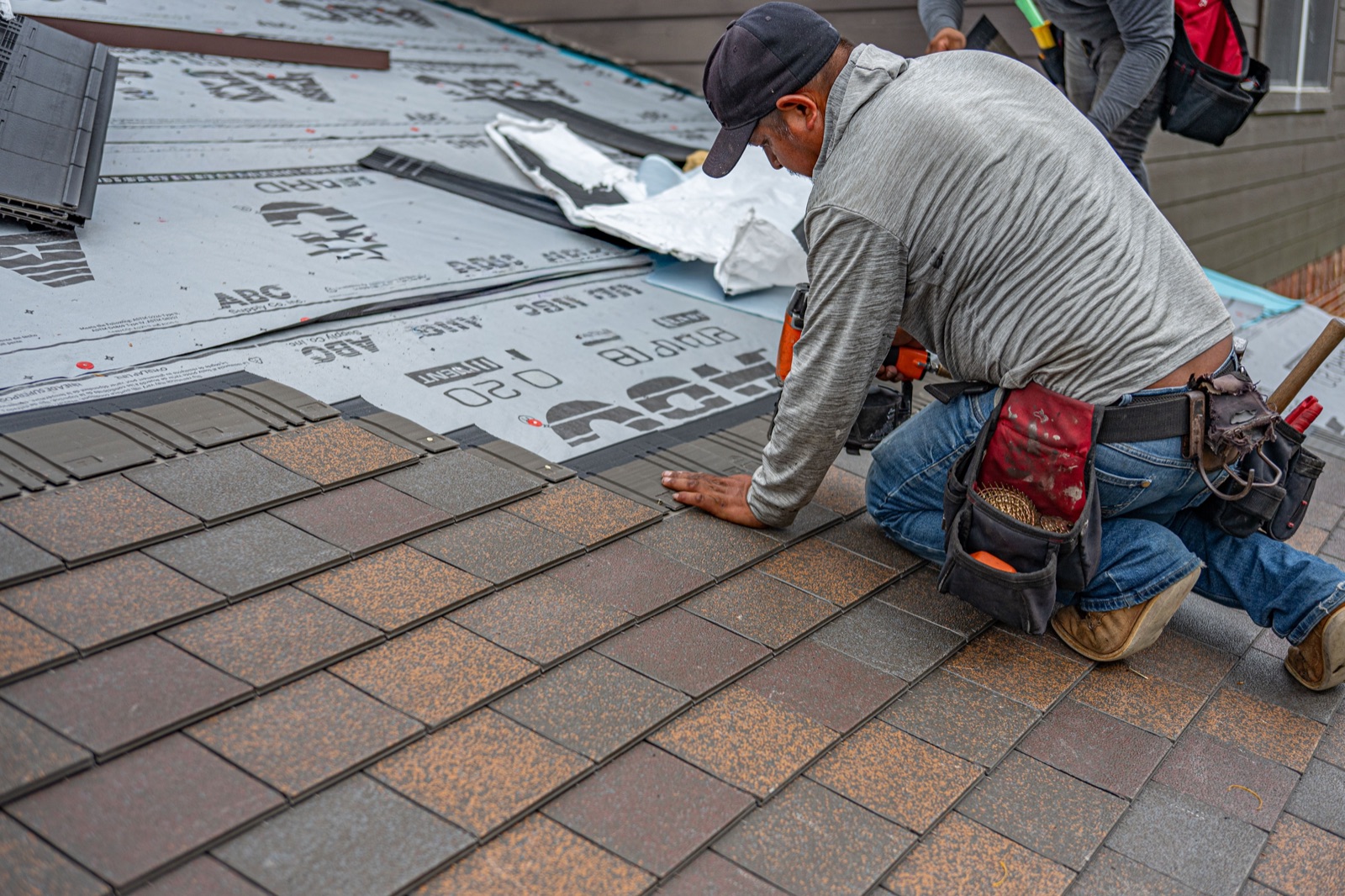
A roofing estimate has two jobs. It has to win the roof, and it has to settle in advance the arguments roofing jobs are known for: how many layers were really on there, who pays for rotten decking, which shingle the customer picked, and what "warranty" means. A clear, itemized roofing estimate does both.
This free roofing estimate template (it works just as well as a roofing quote template) is built for residential re-roofs and repairs. Download it as an editable Word document, an Excel workbook that totals itself, or a printable PDF with the buttons above.
What's in the roofing estimate template
The template runs to two Letter-size pages:
- Your business details and license number
- Estimate number, date, valid-until date and who prepared it
- Customer and job site, with the roof details: roof type, pitch, measured squares, waste factor and existing layers
- Scope of work in plain language
- Itemized lines for tear-off and disposal; decking; underlayment, flashing and ventilation; roofing material and installation; and the permit and other charges
- Subtotal, sales tax and estimate total
- Material options: room for two or three product choices with their price, so the customer picks on the same page
- Decking and hidden damage terms and a Not included list
- Warranty: your workmanship warranty and the manufacturer's warranty, side by side
- Payment schedule and insurance claim details
- Terms and signature lines for the customer and your company
Replace everything in [square brackets] with your own details. In the Excel version, amounts, the subtotal and the total are formulas.
How to fill in a roofing estimate, line by line
1. Measure, then add waste. Roofs are estimated in squares (100 square feet of roof surface). Write the measured squares and your waste factor separately, so the customer sees how you got from the roof to the material order. Hips, valleys and dormers need more waste than a simple gable. If you're measuring from the ground or a plan, the calculator below turns building size and pitch into squares:
For measurements from aerial imagery, see our guide to roof measuring software.
2. Tear-off: count the layers. Price tear-off per square, per layer. Write the number of layers you found on the inspection, and state the price per square for any additional layer discovered during tear-off. That one line prevents the most common mid-job argument.
3. Disposal. Dumpster or dump trailer and landfill fees, as their own line or built into tear-off. Say which.
4. Decking as an allowance. Nobody knows how much decking is bad until the old roof is off. Include an allowance (for example, 3 sheets included) and the price per additional sheet, with the sheet size and thickness. Promise to show the customer the damaged areas or photos before replacing beyond the allowance.
5. Underlayment and ice and water shield. Name the product type (synthetic or felt) and where ice and water shield goes: eaves, valleys, around penetrations, or the whole roof on low slopes. Where your local code requires an ice barrier, the estimate should show it.
6. Flashing and drip edge. List what's new and what's reused: step and counter flashing, chimney and wall flashing, pipe boots, drip edge at eaves and rakes. "Flashing" alone tells the customer nothing.
7. Ventilation. Ridge vent, box vents, intake vents. If you're changing the ventilation, say how and why.
8. Roofing material. Brand, product line and color, plus starter strip, hip and ridge cap. If you offer options, fill in the Material options block instead of picking for the customer.
9. Permit and other charges. Permit fee, gutter detach and reset, skylight work, chimney repairs. Anything you're not doing goes under Not included.
Sales tax: in many states, roofers pay sales tax on materials when they buy them and don't add it to the customer's bill. Check your state's rules for contractors before you fill in the tax line.
Give the customer options
Many roofers price two or three products on the same estimate: a standard architectural shingle, an upgraded line, and maybe a metal roof. The Material options block has room for each option with its product, the manufacturer warranty that comes with it, and the price. The customer ticks one and signs. It moves the conversation from "is this price too high" to "which roof do you want", and it keeps the choice in writing.
For a metal roofing estimate, use the same template: change the units (panels or squares), list the panel profile and gauge, trim, closures and fasteners, and adjust the underlayment line.
Roofing warranty: what to write
The template has a warranty section with two columns, because customers often confuse the two:
- Workmanship warranty. Your promise about the installation. Write the term (for example, [5] years from completion), what it covers (leaks and failures caused by installation), what it excludes (storm damage, damage by others, work by other contractors, lack of maintenance) and how the customer makes a claim.
- Manufacturer warranty. The product maker's warranty, on the manufacturer's terms. Write its name and term, whether it must be registered and who registers it, and whether any enhanced coverage depends on the installer or the system of products used. Read the manufacturer's warranty document before you promise anything about it.
On completion, put the same details on the roofing invoice, with the registration number, so the homeowner has a record.
Sample roofing estimate: a filled-in example
Here's how the line items might look for a re-roof of a 24-square asphalt shingle roof at 6/12 pitch, with one existing layer. All names and prices are made up for illustration; use your own pricing.
| Description | Qty | Unit | Rate | Amount |
|---|---|---|---|---|
| Tear-off and disposal | ||||
| Tear-off, 1 layer (each extra layer $45/sq) | 24 | sq | $70.00 | $1,680.00 |
| Dumpster and disposal | 1 | ea | $550.00 | $550.00 |
| Decking | ||||
| Decking allowance, 7/16" OSB (extra sheets $85 each) | 3 | sheet | $85.00 | $255.00 |
| Underlayment, flashing and ventilation | ||||
| Synthetic underlayment, ice and water shield at eaves and valleys | 24 | sq | $60.00 | $1,440.00 |
| Drip edge, step flashing, pipe boots | 1 | lot | $780.00 | $780.00 |
| Ridge vent | 38 | lf | $9.00 | $342.00 |
| Roofing material and installation | ||||
| Architectural shingles incl. starter and ridge cap (26.5 sq with waste) | 26.5 | sq | $320.00 | $8,480.00 |
| Permit and other | ||||
| Permit | 1 | ea | $175.00 | $175.00 |
| Subtotal | $13,702.00 |
| Sales tax (if it applies in your state) | $0.00 |
| Estimate total | $13,702.00 |
Sample roof repair estimate. Repairs use the same form with fewer lines: "Replace 3 wind-damaged shingles and reseal pipe boot on the north slope, 1 job, $385", plus a line for any minimum service charge. Say what you'll do if you find more damage once you're up there: call the customer with a price before doing more.
Insurance claim jobs
On storm work, the homeowner's insurer pays based on its own estimate of the damage. Put the claim number and carrier on your estimate, keep your line items in terms the adjuster's scope can be compared with, and handle differences with a written supplement or change order, not by quietly changing the price.
Know your state's rules before you write anything about deductibles or the claim. Texas is a good example of how strict they can be. According to the Texas Department of Insurance, a contractor can't act as a public adjuster on a claim for property where they do or may do the work; it's illegal for a contractor to offer to waive, rebate or absorb a policyholder's deductible; and contracts of $1,000 or more involving an insurance settlement must include a notice that the policyholder must pay the deductible. Other states have their own rules; check with your state's insurance department or licensing board. Our roofing marketing ideas cover how this affects your advertising.
Signing at the kitchen table
If the customer signs your estimate in their home, the FTC's Cooling-Off Rule may apply: many sales of $25 or more made at the buyer's home can be cancelled until midnight of the third business day, and the seller must give a cancellation notice. Some states add their own rules for home improvement and storm-repair contracts. The template's terms block has a place for the notices your state requires; check with your licensing board or an attorney.
Estimate, contract, invoice
- Estimate: this template. The price and scope you offer.
- Change order: extra layers, decking beyond the allowance, or anything else that changes the price after signing.
- Roofing invoice: the bill when the roof is done, matching this estimate's lines.
- Contractor estimate template: our general version for other trades.
When to move to roofing software
A template works for a few estimates a week. Once you're measuring roofs from aerial imagery, sending good-better-best proposals, collecting e-signatures and deposits, and ordering materials from the same numbers, software saves real time. Compare the options in our guide to roofing estimate software. Starting out? Our guide on how to start a roofing business covers licensing, insurance and pricing.